
Why Do People in Japan Live So Long — and Should You Get a Health Check Here?
Japan’s world-leading life expectancy (87.33 for women, 81.35 for men in 2025) came mainly from preventing disease across the whole population, especially cutting stroke deaths through less salt and blood pressure control, rather than from high-tech medicine alone. Health checks help most when they look for specific, proven risks like high blood pressure or colorectal cancer, and when people actually follow up on the results.

Japan's Longevity and the Role of Health Checkups
Nov 3, 2026 ·
Why Do People in Japan Live So Long — and Should You Get a Health Check Here?
What really drives Japan's longevity, which checkups are worth your time, and how to get one as an international resident.
In July 2026, Japan's Ministry of Health, Labour and Welfare reported that average life expectancy for 2025 reached 87.33 years for women and 81.35 years for men. Japanese women have ranked first in the world for 41 years in a row. The ministry credited the latest gains to falling death rates from cancer and heart disease.
It is tempting to sum this up as "Japan has great hospitals" or "Japanese people eat healthy food." Both are part of the story, but neither is the whole of it. And the annual health check — something almost every worker in Japan receives — plays a more specific role than most people assume. Here is what the evidence actually shows.
What actually made Japan long-lived
Japan's rise to the top happened fast, and researchers broadly agree on the main drivers. A landmark 2011 series in The Lancet traced it to a steep fall in infectious-disease deaths in the 1950s and early 1960s, followed by a dramatic drop in deaths from stroke.
Stroke prevention through salt and blood pressure. In the 1960s, parts of northern Japan ate around 30 g of salt a day, and stroke was a leading killer. National salt-reduction campaigns and blood pressure screening brought population blood pressure down, and stroke deaths fell sharply. Between 1965 and 1980, lower stroke mortality among people aged 60–74 alone added about a year to life expectancy at birth.
Diet and low obesity. A traditional diet rich in plant foods and fish, small portions, and some modern additions such as dairy are linked to longevity. Japan's average body mass index is among the lowest of rich countries, which lowers the risk of heart disease, stroke and several cancers.
Universal health insurance since 1960's. Everyone can see a doctor at an affordable co-pay, without a referral for clinic visits. That makes it easy to catch and treat problems early — and gives wide access to advanced medical technology.
Community public health. Local governments have long run health education and screening programs. Nagano Prefecture, once known for high stroke death rates, became one of Japan's longest-lived regions through salt reduction, more vegetables and active community health volunteers.
In short: advanced medicine matters, but Japan's longevity was built mainly by preventing disease in large numbers of ordinary people — and that is where health checks come in.
Japan's health check culture
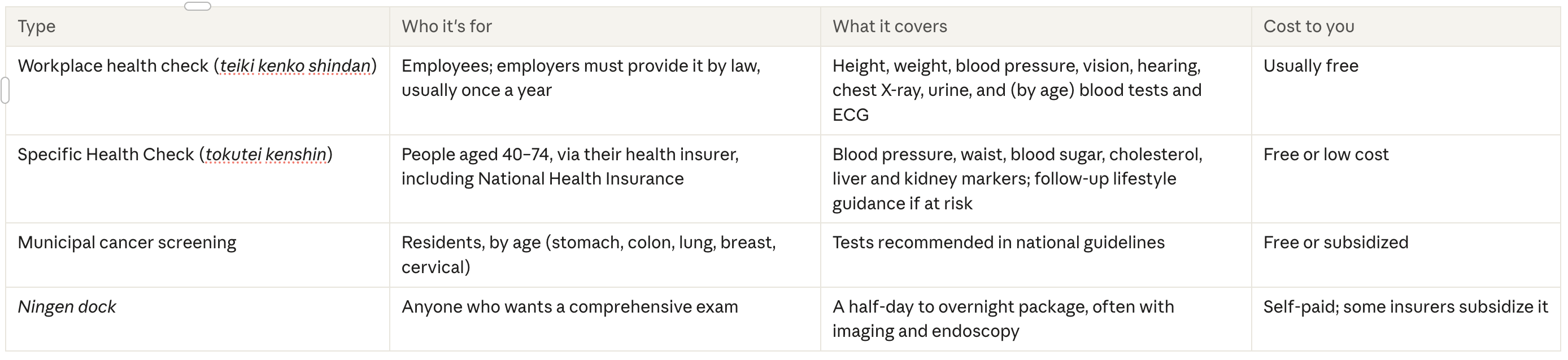
Few countries check the health of so many people so routinely. If you live in Japan, you will likely meet at least one of these:
The system's real strength is not one big exam. It is that blood pressure, blood sugar and cholesterol get measured in tens of millions of people each year, and people at risk are pointed toward treatment early.
Do health checks really work? An honest answer
Health checks work best when they look for specific, treatable problems — and then lead to action. A "check everything" exam on its own is a different story.
The case for caution. A Cochrane review of 15 randomized trials with about 250,000 adults found that inviting the general public to broad health checks made little or no difference to deaths overall, or to deaths from heart disease or cancer. The checks did find more diagnoses, but that did not translate into longer lives. Japan's own data shows a similar pattern for one piece of the system: a 2020 study in JAMA Internal Medicine found that the lifestyle guidance given after the Specific Health Check did not lead to meaningful weight loss or risk-factor improvement among working-age men.
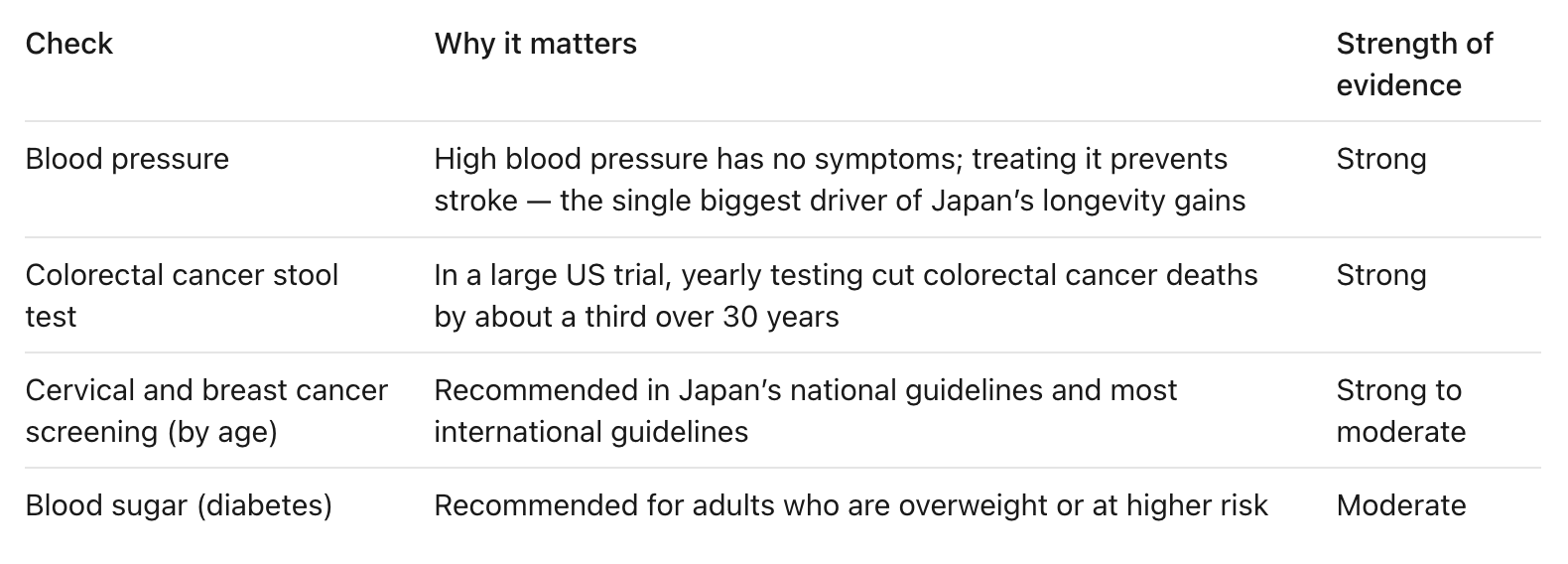
The case for checking. The reviewers themselves stressed that this does not mean people should stop prevention. It means the value lies in the individual tests, not in the package. Several of those tests have strong evidence:
What this means for you. Japan's checkup system works when a high reading is followed by a doctor's visit, treatment or a real lifestyle change. The check is the starting point; the follow-up is what protects your health.
How to get a health check in Japan as an international resident
Start with what's free. If you're employed, your company must arrange an annual check. If you're 40–74 and on National Health Insurance, your city will mail you a ticket for the Specific Health Check, usually in spring.
Check your city's cancer screening. Many municipalities offer subsidized stomach, colorectal, lung, breast and cervical screening by age. Look on your city or ward website, or ask at the health center.
Consider a ningen dock if you want more. It's self-paid, and prices vary widely by clinic and package — often from tens of thousands of yen upward. Ask your insurer whether it offers a subsidy.
Prepare. You'll usually fast from the night before, bring a stool sample collected at home, and fill in a health questionnaire. Bring past results if you have them.
Act on the results. Results often arrive in Japanese with letter grades. Anything marked for follow-up (yō-seimitsu kensa or yō-chiryō) means you should see a doctor — don't let the envelope sit in a drawer.
Not comfortable doing this in Japanese? Find English-speaking clinics for health checks on healthtomo, or describe your concern to Tomo, our AI assistant, to find the right type of clinic.
The bottom line
Japan's long lives were built less by high-tech medicine than by catching common, silent risks — especially high blood pressure — in millions of people and treating them early. Living here gives you easy access to the same system. Use the checks that have proven value, follow up on what they find, and keep the everyday habits that Japan is known for: less salt, more vegetables and fish, and staying active.
The items covered in workplace health checks, the statement that Specific Health Check tickets "usually arrive in spring" (this varies by municipality), the eligible ages for cancer screening, and the romanization of the result grading terms.
- These should be accurate as a general explanation, but please double-check them against the Ministry of Health, Labour and Welfare or local government websites.
This article is for general information and is not medical advice. Talk to a doctor about which checks are right for your age, sex and health history.
Sources
Ministry of Health, Labour and Welfare — 2025 Abridged Life Tables (released July 24, 2026); news coverage of the release
Ikeda N. et al. — Japan: Universal Health Care at 50 Years 1: What has made the population of Japan healthy?, The Lancet, 2011; summary
Tsugane S. — Why has Japan become the world's most long-lived country, European Journal of Clinical Nutrition, 2021
Krogsbøll L.T. et al. — General health checks for reducing illness and mortality, Cochrane Review, 2019
Fukuma S. et al. — National Health Guidance Intervention and health outcomes among Japanese men, JAMA Internal Medicine, 2020
Minnesota Colon Cancer Control Study: 30-year follow-up summary; USPSTF colorectal cancer screening evidence
Nagano Prefecture's longevity efforts, Government of Japan